
What are the key themes you’ll be covering in your ‘Leveraging the web-based visualisation of remotely sensed data for more efficient, cost effective and safer tunnel inspections’ presentation?
The key theme we will be covering within our presentation is the DIFCAM Evolution project, a partnership between Mott MacDonald and the National Physical Laboratory to realise Network Rail’s aspirations of digitising tunnel inspections.
We will first discuss how we utilised Esri’s web-based GIS toolkit to visualise the high-resolution imagery and geometry data created using NPL’s innovative remote sensing technology. We will then discuss how we leverage the many benefits inherent to web GIS in asset management, data capture and collaboration. Finally, we will discuss the incredible potential this digitisation process unlocks for the future of tunnel inspections.
Can you share a bit about your background and career? What unique insights or perspectives do you bring to this topic?
Samuel Li
GIS Consultant, Mott MacDonald
I am a geospatial consultant with 3 years professional experience working with key infrastructure asset owners across the UK and Europe. I believe I can provide insight into how to make use of data analytics and digital technologies to provide effective and innovative solutions.
Heidi Clough
Associate GIS Consultant, Mott MacDonald
I am a geospatial consultant with over 10 years working in Environmental and Engineering consultancies. I believe I can leverage digital technology and automation to maximise the effectiveness of geospatial data for projects across various disciplines.
What key takeaways or actionable points do you hope attendees will take away from your session?
There are three main takeaways we hope attendees will take away from the session:
Gaining an understanding of how digitisation was implemented within a key infrastructure inspection process.
An understanding of what practical benefits web GIS is able to provide and how to leverage them.
Understanding the importance of digitisation for futureproofing processes and how it unlocks further potential for future developments.
In your opinion, what are the key trends shaping the built environment?
In our opinion one of the key trends shaping the built environment is the increased adoption of digital solutions. As digital technology has matured over the last decade, it has found powerful use cases in all areas of the built environment.
The entire industry is beginning to understand the benefits digital solutions can bring, facilitating more efficient data driven and connected thinking. Digital solutions are also an enabler that opens the doors to new emerging technologies like digital twins, automation and machine learning. It is a foundational step in the direction of smarter, more sustainable and interconnected built environments.
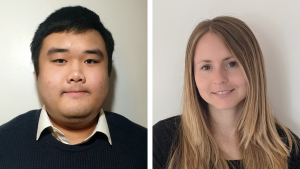 Samuel Li (left) is a GIS Consultant at Mott MacDonald and Heidi Clough (right) is a Associate GIS Consultant at Mott MacDonald. Their joint session ‘Leveraging the web-based visualisation of remotely sensed data for more efficient, cost effective and safer tunnel inspections‘ will take place on day one of GEO Business (5 June 2024) at 12:00 pm – 12:30 pm on the Infrastructure Stage.