
What is the second law of thermodynamics?
Its principle is that everything tends towards disorder, or ‘entropy’. Nowhere can we see a better example of this than in the “catastrophic 73% decline in the average size of global wildlife populations in just 50 years” – World Wildlife Fund (WWF)
In response to species decline the UN adopted a Global Deal for Nature (GDN) , which is a time-bound, science-driven plan to save biodiversity and the abundance of life on earth, based on five goals. In terms of biodiversity, these goals include an attempt to ensure all native ecosystem types are maintained and represented in conservation activities, and that species are ‘saved’ in terms of their viability and distribution. This is how ’30 by 30’ was born – the stated goal to protect 30 percent of the planet and improve 30 percent of degraded ecosystems to a favourable state by 2030.
30 by 30 and why it matters
30 by 30 action is very real and present in the United Kingdom as our Governments attempt to meet the 2030 Global Diversity Framework (GBF) goals. On 26th February 2025, the UK published a blueprint for halting and reversing biodiversity loss within a UK national biodiversity strategy and action plan for 2030 (Department of Agriculture, Environment and Rural Affairs (DEFRA), Scottish Government, Welsh Government, 2025). It binds the four countries to an action plan, with the goal to halt and reverse biodiversity decline implicit in the Convention on Biological Diversity (CBD) objectives. The blueprint provides some statistics about the ‘wonderfully diverse natural environment which is home to over 70,000 species of plants, animals and fungi, including globally significant populations and internationally important habitats.’
Central to governmental and regulatory initiatives is recognition that nature’s contribution to people and their quality of life is profound. The material and non-material contributions of nature to people are summarised in Figure 1. Instinctively, the quality of life improvements provided by nature manifest themselves globally and as part of everyday life. Biodiversity carries significant cultural importance. It not only gives us a sense of belonging but also offers countless opportunities for recreation and inspiration within our diverse landscapes. Engaging in simple activities like walking in open spaces and observing local wildlife can positively affect our mood and both physical and mental health. Moreover, it can also play a crucial role in fostering spiritual and religious connections, shaping our identities, and influencing how we perceive the world and each other. But this is not the only reason to avoid the risk of an extinction event implicit in not pursuing 30 by 30 actions. When nature is lost, so are its contributions to our quality of life and reinstating them becomes even more difficult.

30 by 30 in action
TACP is at the forefront of projects in the UK to assess 30 by 30 habitats and protective measures. We have led the development of methods to baseline map qualifying 30 by 30 areas, first delivering this for Bridgend County Borough Council (BCBC) to support their delivery of the initiative. It was a fascinating first opportunity for us to review potential 30 by 30 sites within the 225 square kilometre local authority area. The information obtained is instrumental for BCBC to develop its local nature recovery action plan.
For land to qualify for 30 by 30 it must be in good condition and have a long-term management plan and/or be in effective management. The site designations for Bridgend are shown in Figure 2.
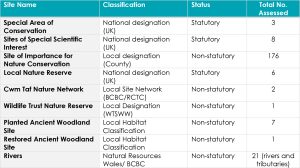
Having designated the sites, TACP surveyors assessed the condition of each site based on a scale (Very Poor > Poor > Reasonable > Good > Very Good). Then, using GIS assessment of area/site statistics, it is possible to quantify potential for the extent of 30 by 30 land.

What did TACP learn from the study?
Based on a rigorous analysis of condition and management plan notes, it was relatively straightforward to propose concrete actions which could be undertaken to move towards 30 by 30 goals. We concluded that early engagement with 30 by 30 brings the potential solutions closer within a clear time constraint.
If we are to mitigate the effects of the second law of thermodynamics then we need to do something urgently.
In the case of biodiversity, whether we like it or not, entropy has been accelerating.
Governments and their proxies can work through international agreements and local project initiatives to reduce the course of global species extinction and environmental destruction.
TACP is keen and willing to play its part by providing intellectual skills and project management resources, to gradually reverse the trend of global decline.
About the Author
Dan Day-Robinson is the Head of Development and Planning at TACP (UK) Ltd and is a former Economic Affairs Officer at the United Nations in Geneva.
At TACP, we understand the urgent evidence-based action required to respond to biodiversity loss and environmental degradation. As a multidisciplinary environmental consultancy and design practice, we take a holistic perspective of science, policy, and place. We provide the technical insight and spatial intelligence needed to support nature recovery and climate resilience initiatives. Our team of ecologists, environmental planners, landscape architects, arboriculturists, GIS analysts, and environmental managers are deeply engaged in delivering real-world solutions that align with the ambitions of the Global Biodiversity Framework and initiatives like 30 by 30.
Through our work, we help create resilient ecosystems, connect communities to their landscapes and enhance biodiversity across a range of environments. From mapping high-value habitats to assessing site condition and advising on strategic land management, TACP offers end-to-end services to support public and private sector partners in halting and reversing biodiversity loss. Our work on Bridgend’s 30 by 30 baseline mapping exemplifies our commitment to translating international targets into local action.