
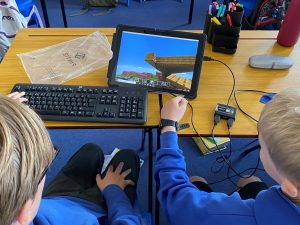
Within the engineering sector we are always looking for new ways to inspire the next generation of engineers: AtkinsRéalis has been working closely with the Digital Engineering Technology and Innovation (DETI) Inspire team at the University of the West of England (UWE) for several years to explore accurate spatial data as a digital twin, delivered via the popular game, Minecraft, to support STEM sessions.
Sustainability and STEM
Sustainability, defined as ‘meeting current needs without compromising the ability of future generations to meet their own needs,’ is currently recognised as a necessary underpinning characteristic throughout engineering, urban planning, and energy sectors, alongside many others. It is therefore critical to entwine sustainability into STEM education. With technology becoming an integral part of our daily lives, knowledge of STEM subjects forms the foundation of our technological and sustainable society, impacting industries such as energy, transportation, food production, and communications (all key areas for sustainable development).
By bringing together STEM education and sustainability education, we empower the next generation to prepare for careers which will transform both our built environment and the environment in which it sits.
In recent years, game-based learning has gained popularity. Research has shown that game-based learning not only makes learning fun but also has a measurable impact on students’ knowledge and understanding. One notable example is the use of Minecraft, a game proven to be an effective tool in increasing student engagement and understanding of scientific concepts.
Minecraft is a sandbox video game developed by Mojang Studios released in 2011. Players explore a blocky, procedurally generated 3D world. There is not a particular narrative or end goal to the game – players are free to mine, build and create to their hearts content. With over 204 million monthly active users (2025) it has a massive young audience, with streaming on YouTube and Twitch making it an ideal tool to engage children – many of whom may not have previously engaged with science learning. A study involving 492 children participating in school-based sessions found significant increases in correct answers on topic-based questions after engaging with Minecraft.
STEM in the community
The West in Minecraft (funded by the Royal Academy of Engineering) is an initiative developed by the DETI Inspire team in collaboration with the Science Hunters programme, both of which are based in the University of the West of England. Building on the evidence that Minecraft is an effective tool in engaging children on scientific issues, further resources were developed to teach students about digital engineering, the engineering design process and sustainability.
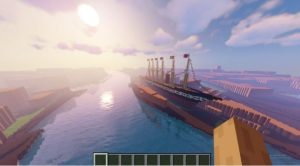
AtkinsRéalis has supported the West in Minecraft and similar initiatives with an automation that translates Ordnance Survey data into a ‘Digital Twin’ of areas around key landmarks and focused locations in Minecraft, based around the schools or community groups where the sessions are being held. This has allowed the children to explore the topics of sustainability and engineering by transforming a virtual copy of their local communities. By asking the question, “What would you do differently if you could redesign your community?” the sessions encourage students to think critically and creatively about their environment.
Between September 2020 and today, over 30,000 students have engaged with West in Minecraft, STEM learning and sustainability, with huge success. There has been much excitement at finding their own homes within the model city, rebuilding structures and adding to existing ones. Students have built more open green spaces, rooftop farms and better active travel networks when encouraged to think about how they would re-design their community for a Net Zero future.
Statistics up to February 2022 show that 53% of children were from areas of high deprivation, hopefully inspiring those children from our most sensitive sectors of society to study STEM subjects and explore careers in engineering and sustainability. Additionally, 42% of student were female, addressing the gender imbalances in a traditionally male dominated sector.
The impact of this initiative is not just reflected in numbers. A word cloud created from students’ feedback included repetitions of words like “exciting”, “fun”, “engineer” and “successful”. These words indicate how students are engaging with sustainability and engineering as a topic and feeling empowered to influence their worlds. Liz Lister from the STEM Ambassador Hub West of England aptly summarised the initiatives’ impact:
“Giving young people access to these places and giving them power to reshape them, even if it is just in Minecraft, offers them the opportunity to imagine their world as being different to what it is now. We hope that planting the idea that we can have some control over our own environment will lead some young people to think about the relevance of design and engineering to their lives, and then perhaps on to thinking of themselves as designers and engineers of the future.”
Initiatives like The West in Minecraft demonstrate the power of integrating game-based learning into STEM education, and the appetite for learners to take active participation in making their communities more sustainable. By making learning engaging and fun, these programmes inspire the next generation of engineers and scientists, equipping them with the skills and knowledge to shape a better future. As educators and professionals, it is our responsibility to continue exploring innovative ways to inspire and empower young minds in our communities.
What can you do?
Meet the AtkinsRéalis team on stand G35 at GEO Business, taking place at Excel London on the 4-5 June, 2025.
Register for your free ticket here
About the Author
AtkinsRéalis is a world-class engineering services and nuclear organisation. We connect people, data and technology to transform the world’s infrastructure and energy systems. Engineering a better future for our planet and its people.
Lewis Mould is an Associate Director in the Geospatial team based in the UK. As part of the Data and Artificial Intelligence Practice, Lewis manage GIS teams supporting large scale multidisciplinary critical national infrastructure, urban design and strategic planning projects across the globe. With a passion for the environment, Lewis uses his expertise to ensure robust data management practices and create automations to enable rapid, data-driven decision making.
Sources: Hobbs et al (2019) – Using Minecraft to engage children with science at public events